Hardwood vs softwood conservatories: Which timber is best?
The short answer: hardwood outlasts softwood by decades, costs more upfront but less over time, and demands far less ongoing maintenance. If you want a conservatory or orangery built to last 50+ years, hardwood, or an engineered timber like Accoya, is the right choice. If budget is your priority right now and you understand the trade-offs, a treated softwood like pine can still be a good starting point.
What is the difference between hardwood and softwood timber?
The distinction comes down to biology, not hardness. Hardwoods come from slow-growing, broad-leafed deciduous trees, think oak, sapele and iroko. Softwoods come from fast-growing conifers, such as pine and spruce.
Because hardwood trees take far longer to mature, the resulting timber is denser, tighter-grained and naturally more resistant to rot and moisture. Softwood grows quickly, which keeps costs low but produces a more porous wood that needs consistent treatment to survive the British climate.
This core difference shapes every decision you make when choosing timber for a conservatory or orangery, from how the structure looks on day one to what it costs to maintain in year ten.
Softwood conservatories: pros and cons

Pine is the most widely used softwood in conservatory building. It is light, easy to work with, and its quick growth cycle makes it considerably cheaper to source than hardwood.
A pine conservatory from Orangeries UK starts from £8,995, making it an accessible entry point for homeowners who want a timber structure without a large initial outlay. The material takes paint and stain well, so it can be finished in almost any colour to suit your home.
Pine is also a reasonable insulator, helping a glazed room stay warmer in winter and cooler in summer, which can reduce energy costs over the year. Many homeowners also find that pine conservatories work well as a glass-roofed garden room or casual dining space, where the lower entry cost justifies a lighter-use build.
Where softwood falls short
The trade-offs are real. Pine is a comparatively soft, porous wood that is more vulnerable to moisture ingress, rot and pest damage than hardwood. Without correct treatment with high-quality preservatives, a pine conservatory will deteriorate quickly in outdoor conditions.
Softwood is also prone to movement: it shrinks and swells as seasonal moisture levels change, which can stress joints, crack paintwork and cause draught gaps around windows and doors over time.
Hardwood conservatories: built for the long term
Hardwood’s density is its greatest asset. Species such as oak, sapele, idigbo, iroko and meranti have a naturally tight grain structure that resists moisture absorption, reducing the risk of rot and the movement problems that trouble softwood frames.
Oak in particular has been used in British buildings for centuries precisely because of its durability. A well-crafted oak conservatory or oak orangery can last 50 years or more with the right care, and its appearance only improves with age as the grain deepens and weathers to a silver patina.
Sapele (sometimes called African mahogany) brings a rich reddish tone and an interlocked grain that is beautiful and stable. Idigbo and meranti offer strong performance at a more moderate cost, making them practical choices for larger glazed structures where volume of timber adds up. They are widely used in high-specification conservatory and orangery builds across the UK.
Hardwood maintenance: what is actually involved?
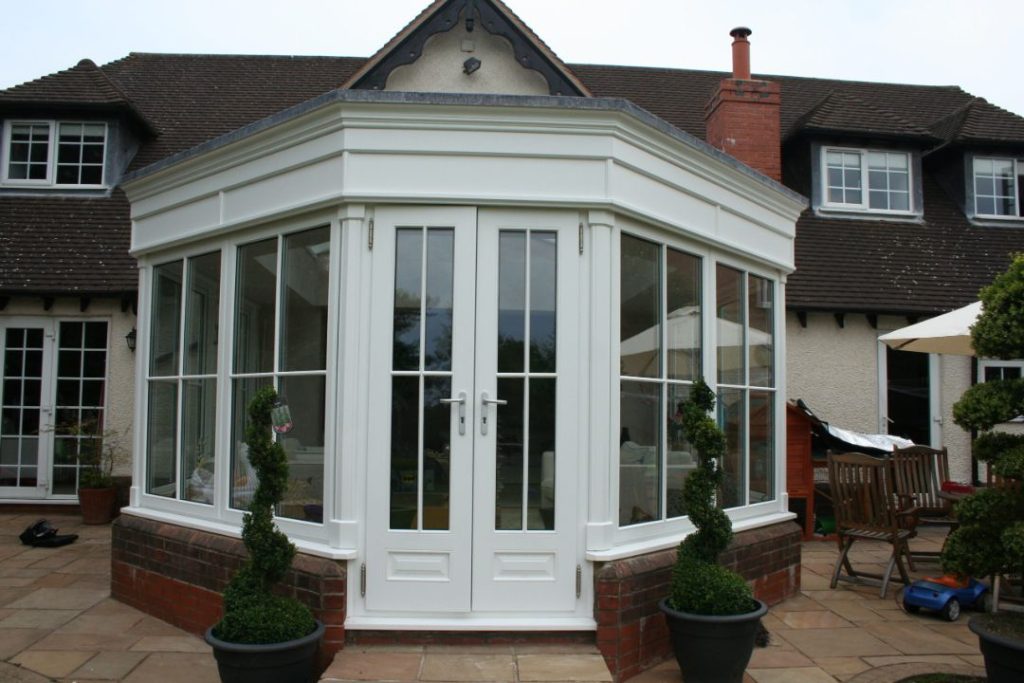
Hardwood frames are able to be repainted and repaired, and with proper maintenance can be expected to last 50 years or more, according to Orangeries UK’s own product guidance. Modern factory-applied finishes have extended maintenance intervals considerably.
In practice, a factory-finished hardwood conservatory typically needs recoating every 8 to 12 years externally, with a lighter inspection every 3 to 5 years. Internal surfaces rarely need anything beyond cleaning.
That is a fraction of the effort required to keep a softwood structure in good condition.
Engineered timber: the performance upgrade worth knowing about
Traditional softwood and solid hardwood are not the ceiling for timber conservatory performance. Engineered and modified timbers, especially Accoya, have changed the landscape for buyers who want the very best long-term result.
Accoya is a modified softwood (radiata pine) that has been acetylated: a process that alters the wood’s cell structure so it no longer absorbs moisture in the same way. The result is a material that is dimensionally stable, rot-resistant, and carries a 50-year above-ground guarantee, outperforming many traditional hardwoods on measurable durability metrics.
All Orangeries UK timber conservatories and orangeries use FSC-certified hardwoods and engineered timbers, factory-finished with one base coat and two topcoats using water-based paints, a standard of finish that reduces the maintenance burden from day one.
The species we work with include Oak, Accoya, Iroko, Sapele, Idigbo, Mahogany and Meranti, each selected for a specific reason depending on the build, the glazing design and what the client wants to achieve.
If you are comparing a timber orangery or an oak conservatory, our team can walk you through which species best suits your home, your budget and the look you are after.
Which timber is best for your conservatory or orangery?
Here is how to think about it depending on your situation:
Choose softwood (pine) if:
- Budget is the primary constraint right now
- You are comfortable with more regular painting and treatment
- You understand the structure may need replacing or major remedial work within 15 years
Choose hardwood (oak, sapele or similar) if:
- You want a structure that lasts and adds lasting value to your home
- You prefer lower maintenance over the long term
- You want the warmth and character of a natural timber grain that improves with age
- You are building an orangery, an extension-style structure or something architecturally considered
Choose engineered timber (Accoya) if:
- Maximum stability and dimensional consistency matter, for large, glazed spans, for example
- You want the longest possible maintenance cycle
- You are in an exposed location where moisture management is especially important
The right answer depends on your home, your plans and your time scale. That is why every Orangeries UK build starts with a proper conversation about what you actually need, not just what fits a standard spec sheet.
Call us on 0333 335 5051 or visit our conservatories page to start your free no-obligation quote.